


Router Settings
Two ways to ask for a model. Name one and nRouter never swaps it, or send nrouter/auto for Best for the task or Lowest cost. Set fallbacks and caching too.
Router Settings (/router-settings) sets how an organization's requests are routed: fallbacks for named models, retry limits, response caching, and how nrouter/auto chooses a model. Owner and Organization Admin roles can change it; everyone else has read-only access. New here? Set up routing walks through the setup in five minutes.
Two ways to ask for a model
Two ways to ask for a model. Direct — you name the model, and nRouter never swaps it for another; a different model answers only through a fallback you configured yourself, and only when the provider cannot take the request. nrouter/auto — nRouter chooses an eligible model for you, by the preference below. Either way, you pay the served model's list price, and x-nr-model names the model that answered.
Router Settings has two pages:
- Direct (
/router-settings): fallback lists for named models, retry limits, wait budgets, and response caching. nrouter/auto(/router-settings/auto): the preference below, and whether new models join automatically. The per-model on/off switches live in Model Catalog → nrouter/auto (/model-catalog/auto), not here.
Withdrawn: Smart Routers and Per-Model Weights were withdrawn on 2026-10-15; requests naming withdrawn aliases return the unknown-model error.
nrouter/auto: the two preferences
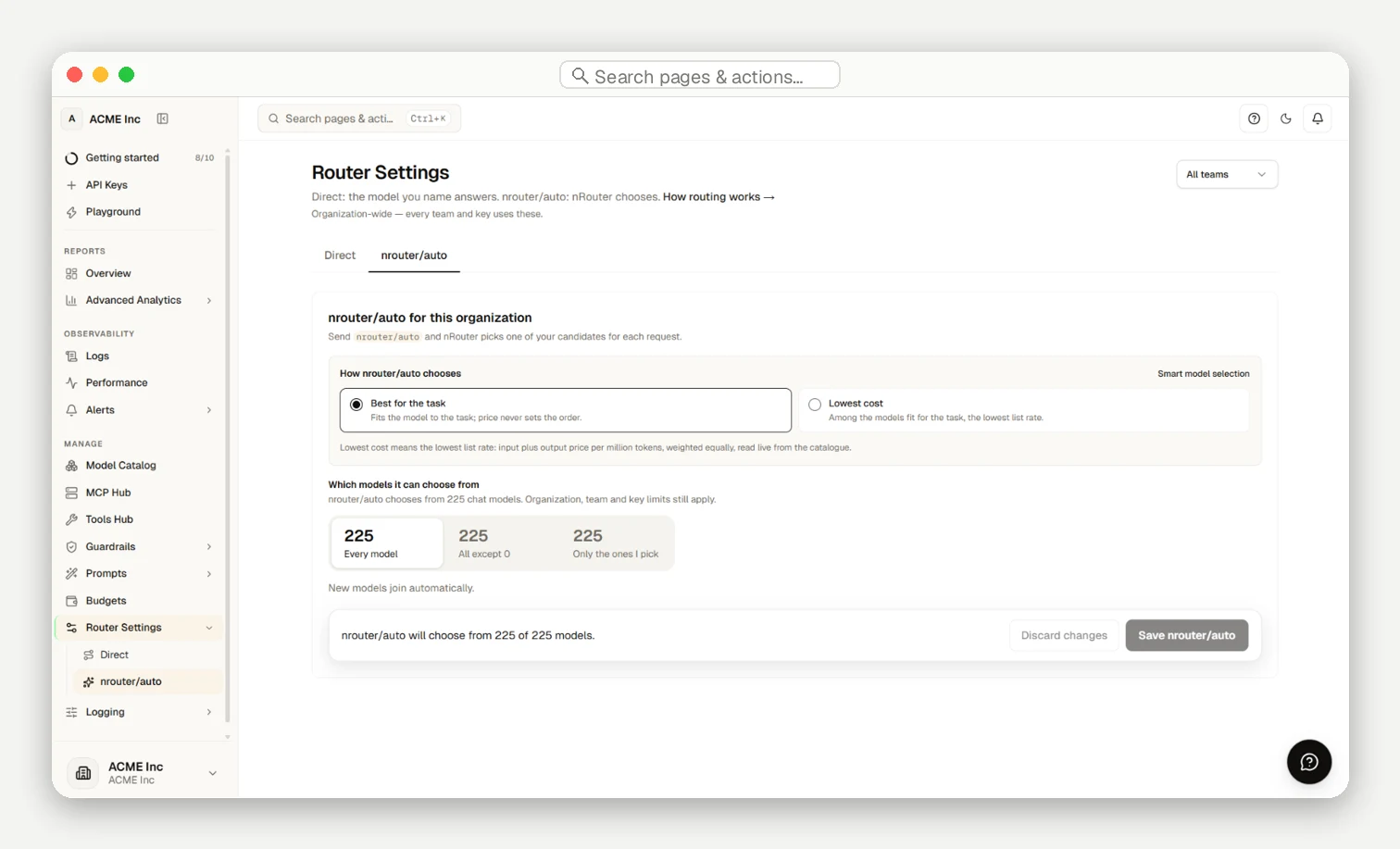
The preference is an organization-wide setting on the nrouter/auto page of Router Settings, changed by an Owner or Organization Admin. Best for the task is the default, and nothing in your code changes: every request still sends nrouter/auto.
| Preference | How the model is chosen |
|---|---|
| Best for the task (default) | A decision model, TypeSafe Jev System One, chooses under a 2,000 ms decision deadline. If it gives no accepted answer in that time, the reviewed default model for the request's tier serves it. |
| Lowest cost | Orders the models fit for the task by the lowest list rate: input plus output price per million tokens, weighted equally, read live from the catalogue. |
Every allowed model is a candidate by default; if every model is off, the gateway refuses with a pre-hold 503. Fit for the task: Three signals mark a request as heavy — reasoning is asked for, the input is long, or the request carries tools and has passed the agentic-turn threshold — and a heavy request is offered heavy models only. The requested output cap (max_tokens) does not choose the tier. Turn off Smart model selection under Settings → Privacy to ensure the prompt is never sent to the decision model — Best for the task may then refuse with a 400 naming the setting, while Lowest cost uses request size and shape alone. Per call, nrouter_optimize: "quality" or "cost" overrides the saved preference (Per-Request Options).
Choosing Lowest cost
Select Lowest cost on the nrouter/auto page of Router Settings. The call itself does not change; it still names nrouter/auto:
curl https://api.nrouter.ai/v1/chat/completions \
  -H "Authorization: Bearer $NROUTER_API_KEY" \
  -H "Content-Type: application/json" \
  -d '{"model": "nrouter/auto", "messages": [{"role": "user", "content": "Hello!"}]}'
Fallbacks and retries
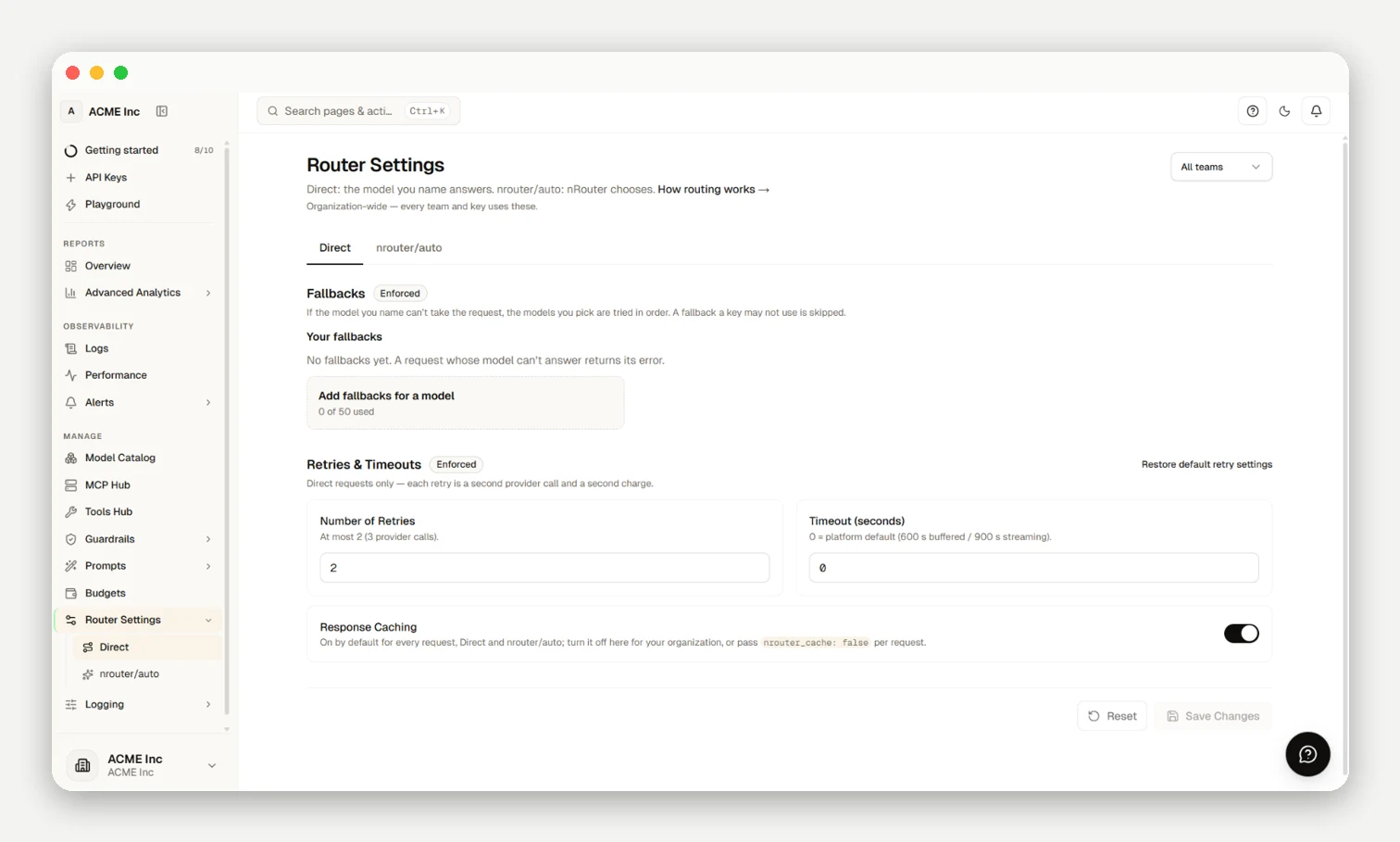
A fallback is tried only when the provider cannot take the request: an upstream 429, 503 or Anthropic 529, a 401 or 404 from a misconfigured provider deployment, a connection that never opened, or a provider that sends no first byte in time. A 500, 502, 504, or any error after response bytes arrive, is returned as-is, never moved. One credit reservation and one rate-limit slot cover the whole chain; override the saved lists per call with nrouter_fallbacks — on nrouter/auto it replaces the fallbacks nrouter/auto would choose; inaccessible targets return 400 fallback_not_allowed.
Retries allow at most 3 provider attempts within a 20-second wait budget, on Direct requests only; nrouter/auto runs its own bounded 3-attempt loop. Response caching is on by default (Response Caching). Every response reports x-nr-model, x-nr-routing (direct or fallback:<n>) and x-nr-attempts — the last two absent on cache hits and refusals. Changes take effect immediately, with no redeployment.
Frequently asked questions
Who on my team can change router settings?
Owners and Organization Admins manage organization-wide settings; Team Admins manage team allowlists; Members have read-only access.
What is the difference between Best for the task and Lowest cost?
Best for the task uses smart model selection when it is available: a decision model chooses the model for the task under a 2,000 ms decision deadline, while Lowest cost orders models fit for the task by the lowest list rate: input plus output price per million tokens, weighted equally, read live from the catalogue.
Does Lowest cost guarantee the smallest bill?
No, because it weights input and output list rates equally without knowing token generation ratios.
What happens when a model fails mid-request?
Failovers trigger only on an upstream 429, 503 or Anthropic 529, a 401 or 404 from a misconfigured provider deployment, a connection that never opened, or a provider that sends no first byte in time; upstream 500, 502, 504 or post-first-byte errors return as-is.